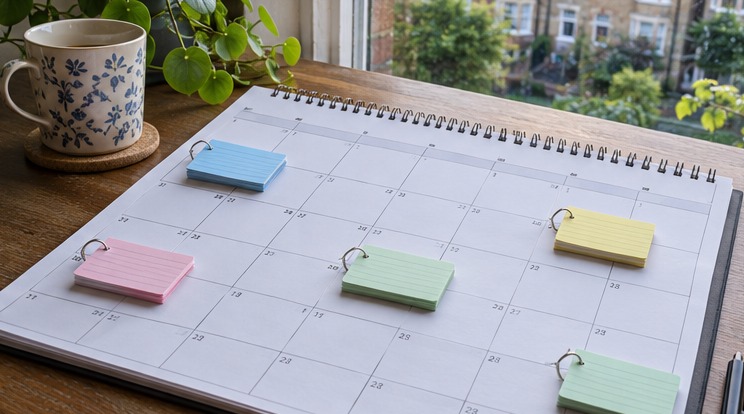
Two staff members have forty minutes to learn a new set of procedures. One spends the time in a single sitting on Friday. The other spends ten minutes on four different days. Both can recognise the material during their last session, yet their schedules create different opportunities to notice what has faded and bring it back. Spacing, also called distributed practice, means separating learning episodes in time. The next session can then begin with a genuine attempt to recover an idea instead of relying on the momentum of the last few minutes.
The gap is part of the design
Cepeda et al. (2006) reviewed distributed-practice experiments involving verbal recall. Their analysis examined both the gap between practice sessions and the time from the final practice session to the test. Those intervals matter together. A plan designed to keep a term accessible for tomorrow can use a different schedule from one designed to keep it accessible across a school term. Research averages cannot specify an ideal interval for every person and task. Prior knowledge, the nature of the material and the opportunities available also influence a practical schedule.
A continuous session has legitimate uses. Someone meeting the material for the first time may need enough uninterrupted time to see how the parts fit. A person reading a technical chapter may benefit from completing a whole worked example before stopping. The spacing decision concerns what happens after that first encounter. Putting a second session on a different day creates an opportunity to find out which parts of the explanation remain accessible once the original page, conversation and immediate cues have gone.
Why a later attempt can feel harder
A phrase that came readily on Friday can take longer to recover on Monday. That delay can feel like a sign that the plan has failed. It can also show where a reminder or a shorter interval would help. Recovering the main idea with effort, then checking the details, offers different information from looking at it repeatedly in a row. When an attempt produces almost nothing, a brief cue or a quick review makes restarting feasible. Pushing the next attempt so far away that it becomes an entirely new lesson can consume time better used elsewhere.
Dunlosky et al. (2013) treated distributed practice and practice testing as distinct techniques with promising applications. They can be combined. Space answers across days and start each short session with a question before revisiting the source. The calendar handles the timing while the question shows what was retained. A learner can also space worked examples, conversation practice or short demonstrations. In each case, choose an outcome that lets the learner see what is improving.
Choose a schedule you can keep
Suppose an adult learner wants to remember twelve new phrases for a discussion group in a fortnight. They might learn four phrases on Monday, practise them from a cue on Wednesday and use them in an improvised dialogue on Saturday. They could repeat that pattern with the other phrases while bringing two earlier phrases into each dialogue. Those days illustrate a workable schedule. The actual interval should respond to missed sessions and to the fluency of later answers.
In a classroom, spacing can be built into arrival routines. A minute on a previous topic at the beginning of a lesson is easier to repeat than an additional revision period that relies on a timetable change. Teachers can alternate between a question from last week and one from a more distant lesson. Give pupils time to answer and check. The aim is to see what is available after a gap and prepare a targeted revisit where needed.
Judge the schedule by the delay that matters
It is tempting to evaluate a timetable at the end of the last practice session. That is when the material is most recent and when the two staff members might look equally comfortable. A more informative comparison comes several days later, using a short demonstration or a fresh example. If the aim is to use a procedure independently, give each person the same scenario and look for the same steps. Measure the part of performance the training was intended to improve.
A useful record can be simple. Write the date, the type of question asked and what was recalled before looking. A person who consistently recovers an idea with little trouble can leave a longer gap or try a more demanding application. A person who repeatedly misses the same distinction can revisit it sooner and clarify it with an example. Spacing is partly a planning technique and partly a way of finding out how long a particular piece of learning remains available in everyday life.
References
Cepeda, N. J., Pashler, H., Vul, E., Wixted, J. T., & Rohrer, D. (2006). Distributed practice in verbal recall tasks: A review and quantitative synthesis. Psychological Bulletin, 132(3), 354–380. https://doi.org/10.1037/0033-2909.132.3.354
Dunlosky, J., Rawson, K. A., Marsh, E. J., Nathan, M. J., & Willingham, D. T. (2013). Improving students’ learning with effective learning techniques: Promising directions from cognitive and educational psychology. Psychological Science in the Public Interest, 14(1), 4–58. https://doi.org/10.1177/1529100612453266