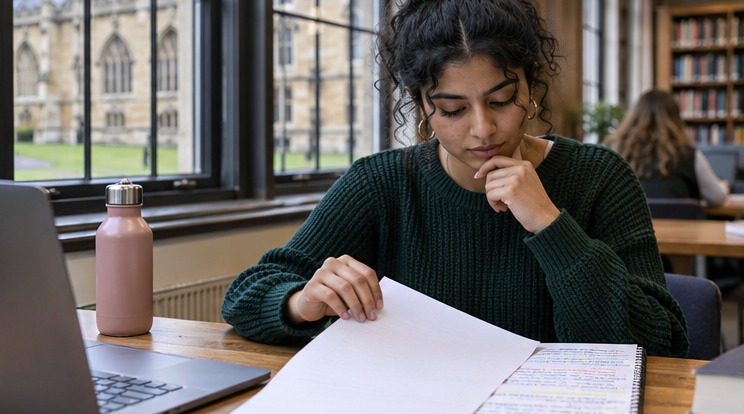
A student closes her notes after reading about the water cycle and tries to explain why clouds form. She can name evaporation and precipitation, but she struggles to say what happens between them. When she reads the same page with the book open, the diagram feels obvious. The difference between those experiences is informative. The open page supplies the words and relationships. The closed book requires her to produce them. Retrieval practice turns that moment of uncertainty into a way of learning as well as a way of checking what she knows.
Remembering is an activity
In a study using prose passages, Roediger and Karpicke (2006) compared additional study with tests that required students to recall what they had read. Repeated study helped on a very short delay in one experiment. On later tests, retrieval practice produced better retention. That change matters because learners typically choose methods using the evidence they can see immediately. An extra reading feels productive when the text is still familiar. A delayed question tests whether the learner can bring the idea back after some of that familiarity has faded.
Attempting an answer and receiving a grade are different experiences. A teacher can ask a class to write down two ideas from yesterday without collecting the papers. A reader can close an article and explain the argument into a voice memo. A colleague in training can talk through a procedure before checking the checklist. In each case, the learner tries to reconstruct a meaningful answer. The activity can take less than a minute. Its value comes partly from making a gap specific enough to address.
What to retrieve
The quality of the question determines what the attempt can reveal. A pupil who recalls the word condensation still needs to explain what condenses and under which conditions. A new employee who remembers that there are three escalation steps may still be unsure which situation triggers each one. To practise flexible use, ask a question that requires the learner to distinguish two examples, explain a cause, or apply a rule to a new situation. Compare that answer with a worked explanation that shows the reasoning.
A research review of learning techniques rated practice testing highly across a range of conditions while distinguishing it from methods whose effects were more limited or dependent on how they were used (Dunlosky et al., 2013). For everyday use, the straightforward implication is to match the practice to the kind of understanding you want. Flashcards work well for vocabulary. If the goal is to interpret a graph, use a graph. If the goal is to explain why a claim is weak, present a short claim and leave room for a reasoned answer.
Keep the attempt and the correction separate
A useful sequence is to give the learner time to answer, then show a trustworthy answer that can be used to revise their own. If the attempt is blank, a cue can make a second attempt productive. In the water-cycle example, a teacher might ask what happens when moist air cools. The learner supplies the next step, looks at the diagram and revises the explanation. The correction is part of the exercise. An unanswered question alone tells the learner where the gap is and leaves the gap open.
It is also worth deciding how much evidence one attempt provides. A single missed answer could reflect ambiguous wording, distraction or a temporary retrieval failure. If a learner succeeds when the question is rephrased, investigate the difference before drawing a conclusion about their knowledge. For classroom use, short written attempts give quieter pupils a way to think before a whole-class discussion. A low-pressure format also lets a teacher distinguish a group-wide misconception from a few individual difficulties.
A short routine for an ordinary week
Pick one small topic that matters next week. On the day you encounter it, write two questions whose answers you can check. Put the source away and try both. Mark which parts of the answer you recovered, and amend a single point that was missing. On a later day, change the example or the order of the questions and try again. Use the second attempt to decide what to practise next. If both answers are strong, move to a more demanding question involving explanation or transfer.
The water-cycle student can eventually move beyond reciting the diagram to explaining why a cold glass develops droplets on the outside. That example changes the surface details while preserving the underlying idea. If she can explain it several days later, the teacher has more useful evidence than another fluent rereading would provide. Retrieval practice works as an ongoing conversation between what the learner can produce today and what they want to be able to use tomorrow.
References
Dunlosky, J., Rawson, K. A., Marsh, E. J., Nathan, M. J., & Willingham, D. T. (2013). Improving students’ learning with effective learning techniques: Promising directions from cognitive and educational psychology. Psychological Science in the Public Interest, 14(1), 4–58. https://doi.org/10.1177/1529100612453266
Roediger, H. L., III, & Karpicke, J. D. (2006). Test-enhanced learning: Taking memory tests improves long-term retention. Psychological Science, 17(3), 249–255. https://doi.org/10.1111/j.1467-9280.2006.01693.x